
Natural Resource Biochem Pvt Ltd (NRBPL)

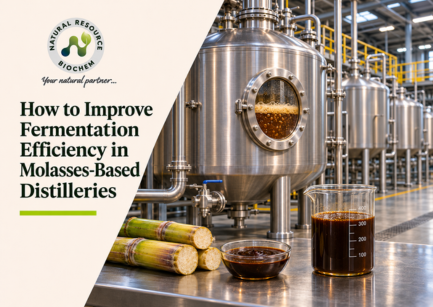
How to Improve Fermentation Efficiency in Molasses-Based Distilleries

Fermentation is one of the most critical stages in ethanol production. For molasses-based distilleries, fermentation efficiency directly influences alcohol yield, production economics and overall plant performance.

However, achieving consistent fermentation performance requires more than simply maintaining fermenters at their prescribed operating conditions. It involves managing raw material quality, yeast health, nutrient availability and process parameters.

Common challenges affecting fermentation efficiency

• Variations in molasses quality and fermentable sugar concentration.
• Inconsistent yeast activity and viability.
• Unbalanced nutrient availability.
• Uncontrolled fermentation temperature and pH.
• Bacterial contamination and unwanted microbial activity.
• Inadequate monitoring of residual sugars and fermentation progress.

How can distilleries improve fermentation performance?

1. Monitor molasses quality: Regular analysis of fermentable sugars, ash, viscosity and other relevant parameters helps in understanding feedstock variability.

2. Maintain yeast health: Yeast propagation, viability, vitality and suitable nutrient management are essential for consistent fermentation.

3. Optimise process conditions: Temperature, pH, fermentation time and substrate concentration should be controlled according to the plant’s process design.

4. Manage microbial contamination: Effective hygiene, sanitation and contamination monitoring help minimise unwanted microbial competition.

5. Use appropriate biotechnology solutions: Specialised enzymes and process additives may support improved substrate utilisation and fermentation performance when their application is technically justified.

The importance of continuous monitoring

Monitoring alcohol concentration, residual sugar, acidity, yeast viability and fermentation time helps identify deviations before they affect production.

Conclusion

Improved fermentation efficiency is the result of disciplined process management supported by scientific analysis and application-specific biotechnology. A consistent approach can help distilleries work towards better ethanol yield and improved operating economics.

admin

How to Improve Fermentation Efficiency in Molasses-Based Distilleries

Innovation alone does not guarantee results. In industrial biotechnology, success depends on how effectively research translates into real-world plant performance. NRBPL’s strength lies in combining deep R&D capability with strong field execution—ensuring solutions work not just in laboratories, but on the plant floor.
Read More »
admin

Reduce Steam Consumption in Sugar Mills and Distilleries

Innovation alone does not guarantee results. In industrial biotechnology, success depends on how effectively research translates into real-world plant performance. NRBPL’s strength lies in combining deep R&D capability with strong field execution—ensuring solutions work not just in laboratories, but on the plant floor.
Read More »

Leave a Reply

Your email address will not be published. Required fields are marked *