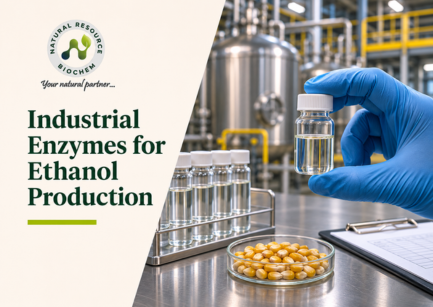
Industrial enzymes play a critical role in modern ethanol manufacturing, particularly in grain-based production systems where starch must be converted into fermentable sugars before fermentation.
The selection and application of suitable enzymes can influence process performance, operating efficiency and the utilisation of raw materials.
Which enzymes are used in ethanol production?
Alpha-amylase: This enzyme facilitates starch liquefaction by breaking down large starch molecules into smaller dextrins. It helps manage slurry viscosity and prepares the material for subsequent processing.
Glucoamylase: It supports saccharification by converting dextrins into glucose, which can then be utilised by yeast during fermentation.
Other specialised enzyme systems: Depending on feedstock composition and process design, additional enzyme applications may be evaluated to improve process characteristics and raw material utilisation.
How do enzymes influence ethanol production?
Enzyme performance is affected by several operating parameters:
• Temperature and pH.
• Enzyme activity and dosage.
• Starch concentration and feedstock quality.
• Residence time and mixing.
• Liquefaction and saccharification conditions.
• Compatibility with the fermentation process.
Why application expertise matters
Simply increasing enzyme dosage does not necessarily improve ethanol yield. The enzyme must be matched to the feedstock, process conditions and desired conversion profile.
Regular analysis of residual starch, fermentable sugar, alcohol concentration and process parameters helps determine whether an application is delivering the intended results.
Conclusion
Enzymes are essential biotechnology tools in modern ethanol production. Their effective use requires scientific understanding, appropriate product selection and continuous process monitoring.