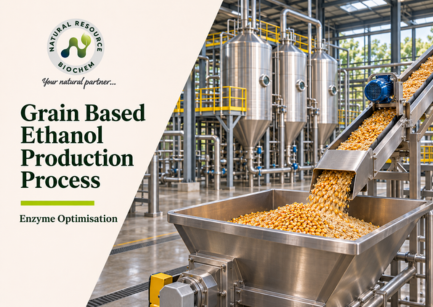
Grain-based ethanol production has become an important part of India’s expanding biofuel ecosystem. Maize, broken rice and other suitable cereal feedstocks are processed to produce ethanol for blending and industrial applications.
However, the economics of grain-based ethanol depend on efficient conversion of starch into fermentable sugars, effective fermentation and the quality of the resulting co-products.
Understanding the grain ethanol production process
The process generally involves:
1. Grain cleaning and milling.
2. Slurry preparation and cooking.
3. Liquefaction of starch.
4. Saccharification to produce fermentable sugars.
5. Yeast-based fermentation.
6. Distillation and dehydration.
7. Stillage processing and DDGS production.
The role of enzymes
Alpha-amylase plays an important role during liquefaction by breaking down starch into smaller dextrins.
Glucoamylase supports saccharification by converting dextrins into fermentable glucose.
Appropriate enzyme selection and application can influence starch conversion, viscosity, fermentation performance and overall process efficiency.
Improving DDGS quality
DDGS (Distillers Dried Grains with Solubles) is an important co-product of grain-based ethanol production. Its nutritional composition, including protein content, depends on feedstock composition, process conditions, solids separation and drying practices.
Therefore, improving DDGS quality requires a broader approach rather than relying on enzyme dosage alone.
Key operational considerations
• Feedstock starch content and variability.
• Milling efficiency and particle size.
• Liquefaction temperature and viscosity.
• Enzyme activity and dosage.
• Fermentation conditions and residual sugars.
• Solids recovery and drying parameters.
Conclusion
Grain-based ethanol production requires coordinated optimisation across the entire conversion process. Biotechnology, process monitoring and technical expertise can help manufacturers improve resource utilisation and operating performance.